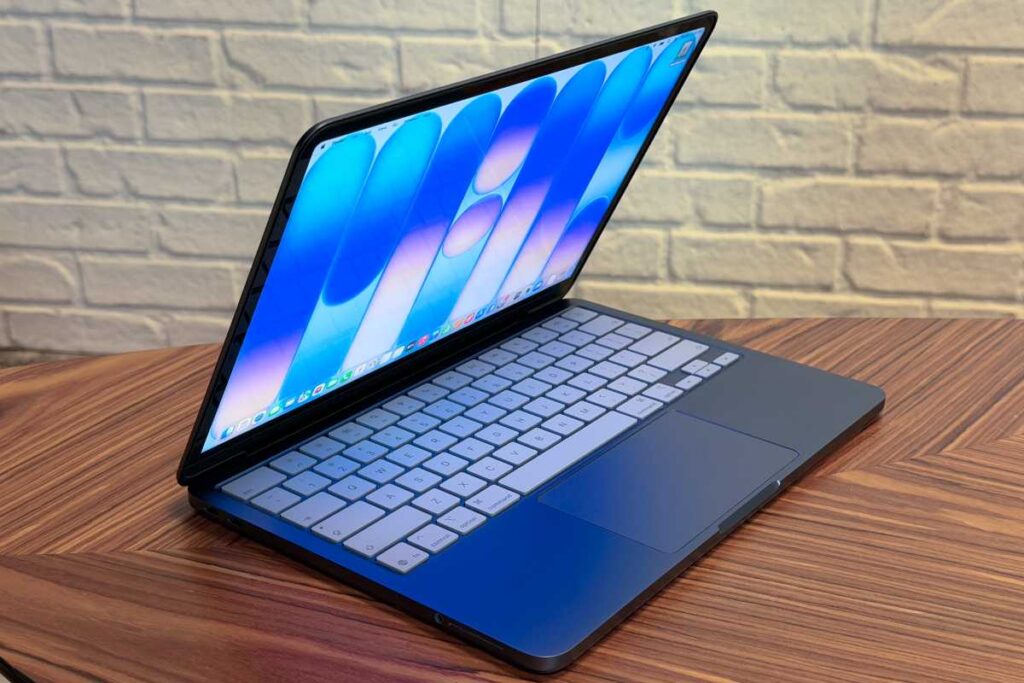

The launch of the MacBook Neo in March sent shockwaves through the personal computer industry.
Although Apple has always been recognized for its laptop production skills, the question of whether it could offer a truly budget-friendly option had been uncertain. Previously, the most economical model available was the original M1 MacBook Air from 2020, which was priced at a relatively steep introductory MSRP of £999/$999.
Then came the Neo. Priced at £599/$599 (£499/$499 for students), it’s the most cost-effective MacBook Apple has ever produced. The inclusion of an A18 Pro chip (the same as what’s found in the iPhone 16 Pro models) is a notable trade-off, resulting in a significant performance drop.
Nevertheless, the reception has been largely positive, with our affiliated site Macworld labeling it as “a joy” and “the ideal entry-level Mac.” Windows laptops at a similar price point do not fare well in direct comparisons.
Foundry
With Linux and ChromeOS lacking sufficient third-party software for mainstream consumer acceptance, the Neo stands as the sole affordable laptop option. Record-breaking sales following the launch are a testament to its impact.
How long can this lead continue? Windows laptop manufacturers appear caught off guard by this fresh competition; however, could Google have a secret weapon?
With the introduction of a new Android-ChromeOS hybrid, the newly announced Googlebook devices might present a legitimate alternative to the MacBook Neo. Here are five significant advantages.
Google’s ecosystem rivals Apple’s
The Apple ecosystem is rightly praised for the seamless connectivity it provides among various devices.
It’s remarkably simple to initiate a task on your iPhone while out and then continue right from where you paused on an iPad. Or enjoy music on your AirPods while moving around, then quickly switch to a TV show on your MacBook upon returning home.
For those who already possess such devices, the MacBook Neo is an obvious choice. Even Google recognizes the “ecosystem advantage” enjoyed by Apple, citing it as a crucial motivation for its actions.
It’s remarkably simple to initiate a task on your iPhone while out and then continue right from where you paused on an iPad
Conversely, if you own an Android phone, the decision becomes much more complicated. While all of Google’s apps are accessible on the Mac, they lack the cohesive ecosystem features present in Apple’s offerings. On Windows, Microsoft’s Phone Link application provides only minimal integration with an Android device, revealing a clear market gap.
Microsoft
With an impressive array of popular productivity applications, Google is better situated than any other company within the Android framework.
Google Search, YouTube, Maps, Gmail, Chrome, Docs, Photos, and Calendar are all integral to my daily activities, and I can’t imagine managing without them. I’m aware I’m not in this alone.
On Android, I feel completely at home, yet transitioning to a laptop always presents challenges. The current version of Android is ill-suited for cursor-based navigation, necessitating a dedicated operating system.
It appears that Google is providing exactly that with AluminiumOS, which aims to blend aspects of Android and ChromeOS.
The Android integration will be exceptional
The idea of a true desktop version of Android has me eagerly anticipating the integration possibilities with an Android phone.
In comparison to the iPhone and Mac, the relationship between Android and Windows is significantly lacking. I expect Googlebooks and AluminiumOS to deliver a substantial improvement over the current setup.
Envision using your Android phone camera as a desktop webcam, seamless earbud switching, and having a universal clipboard that syncs whatever you copy from either device.
Apple
I also appreciate how effortlessly one can manage both an iPhone/iPad and Mac using a single cursor and keyboard by placing them side by side. Or continue your web browsing or other applications exactly as you left them.
These features are currently offered by Apple, and Google is well-equipped to match this, particularly on Pixel phones. According to Googlebooks, users will be able to run phone applications directly on their laptops or swiftly access files from their phones through the browser. This level of integration is precisely what I’ve been wishing for.
And Gemini surpasses Siri
It’s no surprise that Google has confirmed Gemini will be integral to AluminiumOS.
And why wouldn’t it be? AI is a hot topic nowadays, and Google appears to be excelling more than any other company in this domain.
Apple has suffered from a lack of advancements in AI
In the realm of smartphones, Gemini is breaking new ground, providing a comprehensive, user-friendly means to incorporate AI into daily life. Initially doubtful, I’ve come to recognize Gemini’s consistent value, which I can no longer overlook.
Foundry
In contrast, Apple has been hindered by limited AI advancements, with updates to its antiquated Siri assistant progressing at a sluggish pace.
With Gemini Intelligence, Google aims to broaden its lead by rolling out AI agents that function in the background to complete tasks. While I’m generally skeptical about AI agents, I trust Google more than any other company to create a service that truly assists users. Perhaps my bias is apparent.
Is Google reinventing the cursor?
Similar to typing, Google is also targeting an enduring aspect of computing: the cursor.
The traditional arrow icon has remained unchanged for more than five decades—until now. The simple cursor will receive an upgrade in 2026, now referred to as a ‘Magic Pointer.’
And, unsurprisingly, Gemini is at its core. A mere motion can activate Google’s AI assistant, providing context-driven suggestions related to the information displayed.
Examples of its capabilities include rapid comparisons of selected images and dates effortlessly creating calendar events—but this is probably just the beginning.
If it works as envisioned, I could see the Magic Pointer being adopted across all desktop PCs—including Macs.
Google isn’t producing Googlebooks itself…
Google’s history with first-party laptops isn’t particularly stellar. Following the debut of ChromeOS in 2011, the company released various proprietary Chromebooks over the years.
However, these never achieved lasting success, despite the undeniable quality of models like the 2019 Pixelbook Go.
Hannah Cowton-Barnes / Foundry
That was the last Google-branded laptop released, with the company shifting its focus entirely to the ChromeOS software experience available on other manufacturers’ devices.
I feared that Google might attempt to revive first-party laptops with Googlebooks, but I was happily incorrect. It appears the company has learned from its past and is now focusing solely on its strengths—superb software.
Considering it’s a completely new operating system built from scratch, AluminiumOS will likely need Google to devote its full attention, making this a wise decision.
…but some of the top PC manufacturers are
If Google struggled to engage leading laptop brands in developing Googlebooks, I would suggest investing in proprietary hardware. However, that clearly isn’t the case.
Numerous prominent Chromebook producers are already on board, including Acer, Asus, Dell, HP, and Lenovo. More manufacturers are likely to follow suit.
Those companies already possess a proven track record of delivering hardware that complements Google’s software, making it reasonable to expect they will continue to do so.
Numerous prominent Chromebook producers are already on board, including Acer, Asus, Dell, HP, and Lenovo
With multiple manufacturers already aligned, you will have an advantage that the MacBook Neo cannot offer: variety. Google indicates that Googlebooks will come in “an array of shapes and sizes,” suggesting there will be a device for nearly everyone.
Foundry
Moreover, similarly to the MacBook Neo, build quality shouldn’t be sacrificed, as Googlebooks are expected to be crafted with “premium materials and craftsmanship.”
While undeniably more sophisticated than Chromebooks, Googlebooks will have an excellent chance to rival or even lower Apple’s laptop pricing while providing the best possible options for Android phone users.
Overall, it’s a thrilling time for Google and the laptop industry as a whole. The MacBook Neo may entice Android users for a bit longer, but Googlebooks positions Google effectively to retaliate.
For the first time in a long while, I feel genuine excitement about the future of laptops.
Summary
The Geordie’s Takeaway: “Apple has introduced the MacBook Neo – affordable indeed, but Google’s Googlebooks are poised to challenge them. Variety is essential, and Google’s offering a plethora for Android enthusiasts. Stay alert, folks; this is set to be thrilling!”