
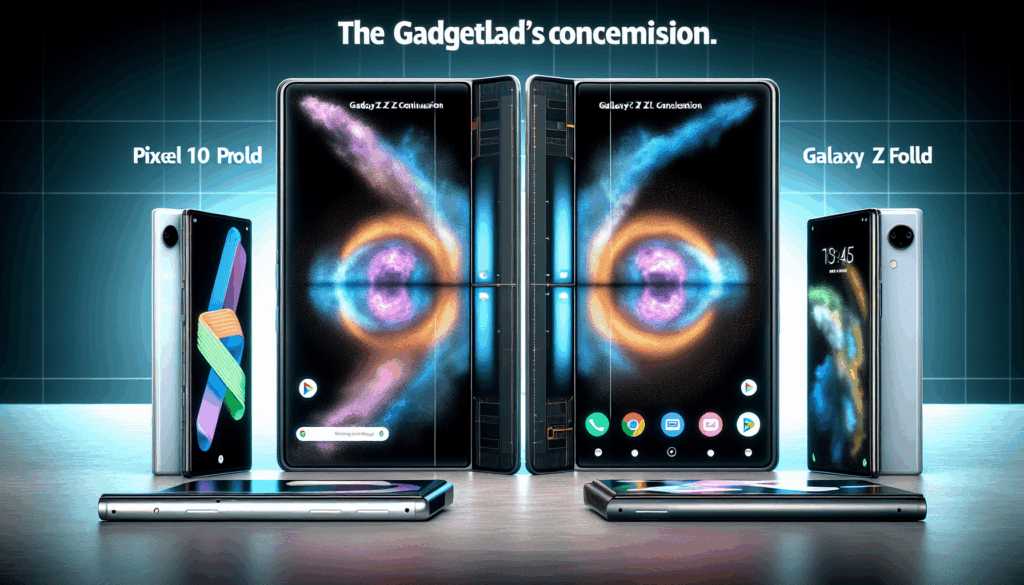

The Google Pixel 10 Pro Fold has arrived, boasting an IP68 rating and Pixelsnap magnets for the first time in a foldable device. If you’re on the lookout for an upgrade, it might just be the right moment to explore the foldable experience.
However, Google isn’t the sole significant contender in the foldable industry. Only a few months ago, Samsung impressed us with its streamlined and enhanced Galaxy Z Fold 7. Can this latest model stand up to competition?
I’ve dedicated some quality time to both devices, and I have a wealth of opinions. So, let’s delve deeper and examine how these foldable smartphones compare.
Design
The Pixel 10 Pro Fold and Galaxy Z Fold 7 embody distinctly different design philosophies. The Samsung has undergone a total design refresh for 2025, while the Pixel resembles its predecessor significantly. Nevertheless, each has its distinctive advantages, and the design will significantly influence your preference between the two.
Luke Baker
Focusing on the Galaxy Z Fold 7, its appeal lies in its sleek and lightweight build. When closed, it could easily pass for a typical flagship phone. It actually weighs less than the non-foldable Galaxy S25 Ultra, and is similarly thin.
If you’re in search of a folding device that feels like a regular smartphone, the Z Fold 7 arguably stands out as the best in the market. It features extremely thin bezels and sharp, angular aesthetics, which enhance screen space on both the exterior and interior displays.
Luke Baker
On the other hand, the Pixel 10 Pro Fold is nearly its diametrical opposite. It has a thickness of 10.8mm when closed, contrasted with only 8.9mm, and it weighs 258g, against just 215g for the Samsung. The difference is apparent when you handle both. The Pixel also sports soft, rounded corners on each display and somewhat bulky bezels.
Nevertheless, the design of the Pixel is not without its allure. It gives an impression of remarkable sturdiness, which isn’t something typically associated with foldables. This is underlined by its IP rating, as it’s the first foldable to achieve an IP68 rating, implying it’s largely protected from dust and water; in contrast, the Fold 7 is only rated IP48, which may expose it to dust-related issues.
Luke Baker
Furthermore, it’s the first foldable to incorporate the Pixelsnap feature. This is essentially Google’s version of Apple MagSafe, functioning in an identical manner; you can even use most of Apple’s MagSafe accessories with this device (with certain limitations).
Samsung does offer magnetic cases that provide similar capabilities, but with the Pixel 10 Pro Fold, purchasing a case is not mandatory.
Displays
The Pixel 10 Pro Fold features a 6.4-inch cover display, while the Galaxy Z Fold 7 has a 6.5-inch screen, and both showcase 8-inch foldable panels internally.
Though it may not seem like a significant difference, the user experience feels quite distinct. As noted previously, this is due to the Pixel’s rounded corners, while the Samsung displays sharper edges.
Luke Baker
In my experience, the Samsung screens appear significantly larger because content can reach those sharper edges. I found this particularly evident on the outer display, though less so on the folding screen. The Pixel’s cover display feels somewhat confined in comparison.
Conversely, the Pixel’s soft corners make it more pleasant to hold, especially when unfolded. I also value the more pronounced bezel on the folding display, which provides a gripping area without inadvertently pressing icons on the display.
The Pixel screens can achieve slightly higher peak brightness, yet in practical use, they look notably alike. It’s worth mentioning that the Samsung dims its screen to prevent overheating in bright sunlight. The Pixel may also do this, but the weather has been quite gloomy since I obtained it, making it hard to evaluate.
Luke Baker
Regarding the crease, Samsung has a clear advantage. It’s significantly less perceptible on the Z Fold 7 compared to the Pixel 10 Pro Fold. Naturally, you will acclimatize to the crease over time, but if you are sensitive to such details, you might prefer the Samsung.
Performance
The Samsung Galaxy Z Fold 7 is equipped with the Qualcomm Snapdragon 8 Elite, recognized as the fastest mobile chipset until the 8 Elite Gen 5 was revealed recently. In contrast, the Pixel 10 Pro Fold employs Google’s Tensor G5 chip.
The Tensor G5 represents a considerable enhancement over its predecessor, delivering notably higher benchmark results and a snappier feel during use. Unfortunately, it still lags behind the Snapdragon in speed.
Luke Baker
How significant this is will largely depend on your intended phone usage. For casual tasks like browsing social media, replying to emails, and photo editing, you’d likely notice no difference. Both devices are exceptionally fast and responsive regardless of how many apps are open.
The distinction only becomes clear during intensive tasks like playing graphically demanding games such as Wuthering Waves, or when performing heavy video edits, like stitching together multiple 4K clips in LumaFusion. Under these circumstances, the Z Fold 7 is the more suitable option.
The Pixel is still capable of handling virtually any task, but it will show signs of strain, and you may notice considerable heat buildup when pushing it to its limits.
Dominik Tomaszewski / Foundry
Both smartphones start with 256GB of storage in their base model, with options to upgrade to 512GB or 1TB. However, in terms of RAM, the Pixel is ahead: all models of the Pixel 10 Pro Fold come with 16GB of RAM.
The 256GB and 512GB versions of the Z Fold 7 come with only 12GB, and you’d need to opt for the expensive 1TB model to acquire 16GB.
Will this difference be notable in real usage? In my experience, not really. Both devices excel at multitasking, and I never felt that the 12GB RAM of the Fold 7 was insufficient.
Cameras
Both smartphones are equipped with a triple-camera system on the rear and a selfie camera on each screen. For both, you have an ultrawide, a main sensor, and a telephoto lens, but the Pixel features a 5x lens while the Samsung offers a 3x lens.
Luke Baker
The primary sensor specifications reveal the most significant difference. The Pixel 10 Pro Fold includes a 48Mp 1/2-inch sensor, while the Z Fold 7 showcases a 200Mp 1/1.3-inch sensor. This means not only greater resolution but also improved performance in low-light scenarios.
I have extensively tested both camera systems, and across most situations, the Samsung produces superior image quality. That doesn’t imply the Pixel is subpar; in some cases, the images may appear more aesthetically pleasing right out of the camera, but upon close inspection, the details in Pixel shots tend to falter.
The advantage of the Pixel lies in its user-friendliness. The camera application is exceptionally easy to navigate and use, packed with features that cater to beginners. For example, there’s a Camera Coach mode that helps in taking the most Instagram-worthy shots in any context.
Luke Baker
Samsung adopts a different perspective. Their camera app is filled with features that attract professional photographers. It offers extensive manual controls, and you can even capture Log video.
Which camera system suits you better ultimately hinges on your unique needs. As a long-time photography enthusiast, I found Samsung’s approach to align with my interests, but I can also appreciate the straightforwardness of Google’s application.
Other differences
Another significant distinction between these devices lies in the software. Sure, both run on Android 16 and offer 7 years of updates, but Samsung’s One UI overlay creates a distinct look and feel compared to the Pixel 10 Pro Fold’s standard Android aesthetics.
Luke Baker
Determining which is superior is entirely subjective; every operating system has its unique strengths.