

The latest foldable devices from Samsung have arrived, and there’s plenty to discuss.
This marks the introduction of two book-format models for the first time. Contrary to what its name might suggest, the Galaxy Z Fold 8 is an entirely new creation, while the rebranded Z Fold 8 Ultra serves as the natural evolution of last year’s Z Fold 7.
If you’ve viewed a side-by-side image of the two devices (as seen in the picture above), the difference is immediately apparent. So, is it simply a matter of choosing between a compact, stout model and a taller, slim one?
Not at all. Although the design may sway your preference, the chosen device will differ significantly in multiple crucial aspects.
Curious about our thoughts on them? Check out our hands-on reviews of the Galaxy Z Fold 8 and the Galaxy Z Fold 8 Ultra.
The design
Let’s begin with the obvious differences. The Galaxy Z Fold 8 and 8 Ultra present distinct appearances, making them ideal for different applications.
The Fold has long been marketed as a device for productivity, and Samsung is further reinforcing this with the ‘Ultra’ label. Its dimensions and weight of 215g are the same as the Z Fold 7, meaning the 8-inch internal display offers an area equal to two 6.5-inch cover screens side by side.
Luke Baker
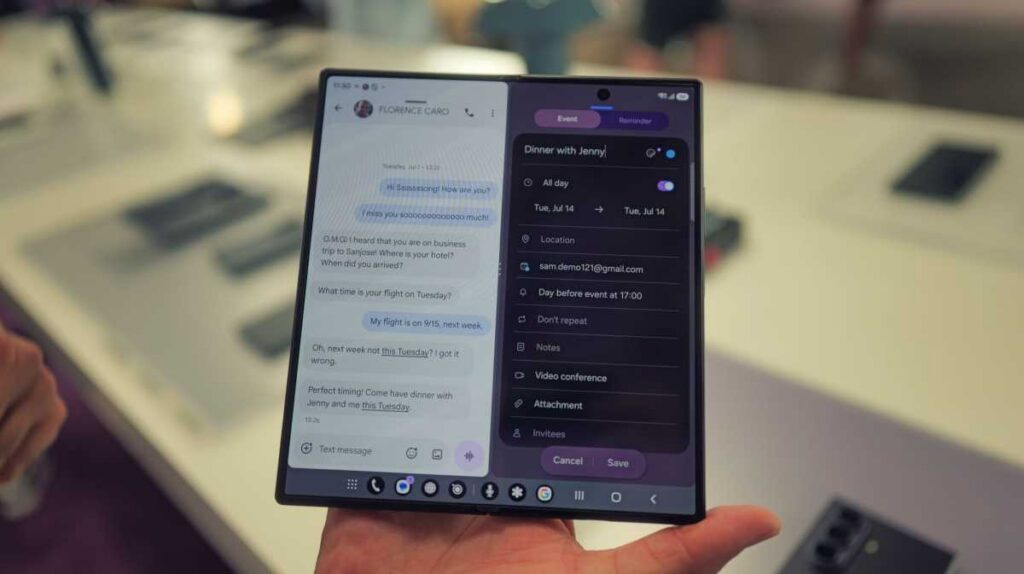
Consequently, it excels in multitasking, a vital aspect of many productivity tasks on screen. Innovative features such as ‘Now Nudge’ are designed to leverage this, with a single tap on the AI-generated cue directing you to a beneficial split-screen view.
On the other hand, the Galaxy Z Fold 8 is comparatively shorter and broader. Its 5.5-inch cover screen can feel cumbersome for vertical video or single-handed use, but the real benefit emerges when you unfold it. Instead of an almost square display, the 7.6-inch internal screen adopts a more conventional 4:3 aspect ratio, making it far more suitable for standard widescreen content.
Luke Baker
If you’re looking for a device to enjoy films and TV shows or to emulate a standard tablet experience, the Z Fold 8 is undoubtedly a superior option. It’s also notably lighter, weighing in at just 201g.
In other words, while the Galaxy Z Fold 8 Ultra is perfect for platforms like TikTok and YouTube Shorts, especially if you want to view two videos simultaneously, the Z Fold 8 stands out as the better choice for longer content or gaming.
The cameras
Considering the high price of these devices (more details on that later), you’ll want to utilize them as your primary smartphone. Thus, the camera systems must be of high quality.
The Galaxy Z Fold 8 and Z Fold 8 Ultra share some camera specifications, including a 50Mp ultrawide lens with a 120-degree field of view and 10Mp front-facing cameras on both displays. However, that’s where the commonalities conclude.
Samsung has outfitted the pricier Ultra with a significantly more advanced camera system, including the same 200Mp main sensor found in last year’s Z Fold 7. While the absence of an upgrade may be disappointing, it at least doesn’t entail a downgrade like that seen in the Z Fold 8, which features the same 50Mp sensor as the more affordable Z Flip 8.
Luke Baker
From our encounters with last year’s Z Flip 7 (which shared this lens), it’s a very competent camera, although a notable downgrade from the 200Mp.
However, perhaps the most surprising element of the entire Z Fold 8 experience is the absence of a telephoto lens. While the Z Fold 8 Ultra forgoes the S26 Ultra‘s 50Mp, 5x periscope telephoto, it does retain the standard 10Mp lens, enabling 3x optical zoom.
Luke Baker
Consequently, zoom photography will likely be a limitation of the Z Fold 8. It’ll depend entirely on digital zoom, which merely crops in on the primary sensor instead of preserving true quality. If you’re particular about this or desire compelling portrait-style images, the Z Fold 8 Ultra will almost certainly be the superior choice.
That said, it’s worth mentioning that the Z Fold 8 Ultra is unlikely to pose a serious challenge to the S26 Ultra or other top-tier camera phones for photography or videography.
The battery
Alongside the Galaxy Z Flip 8, the Z Fold 8 and Z Fold 8 Ultra are the first Samsung smartphones to incorporate a silicon-carbon (Si-C) battery. Hooray!
This means the battery capacities for both are enhanced compared to the 4400mAh of the Z Fold 7, though don’t anticipate vast sizes rivaling other brands’ models.
Luke Baker
Specifically, the Z Fold 8 has a 4800mAh cell, while the Z Fold 8 Ultra increases that to 5000mAh. However, the additional 200mAh may be negated by the larger screens, particularly since both devices utilize the efficient Snapdragon 8 Elite Gen 5 for Galaxy chipset.
Luke Baker
The charging capabilities are identical across both phones, providing 45W and 20W wireless speeds. However, there’s still no built-in Qi2, meaning you’ll require a case to utilize magnetic charging and accessories.
The colours
Both the Galaxy Z Fold 8 and Z Fold 8 Ultra come in standard color options: ‘Graphite’ (dark grey) and ‘Cream’ (off-white).
Moreover, the Z Fold 8 introduces a light purple shade known as ‘Lavender’, while the Z Fold 8 Ultra features a striking ‘Violet Shadow’.
A similar trend can be seen with the green shades, with a lighter ‘Pistachio’ on the wider model and a darker ‘Green Shadow’ on the Ultra. These variations are also exclusive to the Samsung store.
The price
It’s clear that both foldable devices are high-end, which is reflected in their pricing. Nonetheless, there is some disparity between the two.
The Galaxy Z Fold 8 begins at £1,699/$1,899, whereas the Fold 8 Ultra will cost you at least £1,899/$2,099. This positions it between the launch price of the Z Fold 7 last year, which was £1,799/$1,999.
Both models are available for pre-order now, ahead of their release date on August 7. While contract deals may be competitive, if you want to save some money, opting for the Z Fold 8 is wise.
- Pre-order the Galaxy Z Fold 8 in the UK
- Pre-order the Galaxy Z Fold 8 Ultra in the UK
- Pre-order the Galaxy Z Fold 8 in the US
- Pre-order the Galaxy Z Fold 8 Ultra in the US
Just keep in mind, numerous excellent budget, mid-range, and even flagship smartphones cost significantly less.
Summary
In summary: Are foldables here to stay, or just an elegant form of origami?
