

The battle for the ultra-premium tablet has been reignited.
Samsung unveiled its Galaxy Tab S11 Ultra in September, and Apple has responded with a new 2025 iteration of the iPad Pro. At first glance, both devices share several similarities – stylish aesthetics, expansive screens, and some of the most impressive performance found on their respective platforms.
Nonetheless, they also exhibit notable differences, which will likely influence your choice. The iPad Pro boasts numerous advantages, including M5 performance – a feature that could outshine all Android tablets – along with a multitude of high-quality, dedicated iPad applications.
If I were to choose between the two, I would undoubtedly pick the Tab S11 Ultra. Here’s why.
It’s sufficiently large to truly replace my laptop
When I’m investing £1,000/$1,000 or more in a tablet, it ought to be capable of substituting my laptop.
This may not be feasible for some power users, but as someone who primarily depends on web browsing and a limited selection of mobile-friendly applications to complete tasks, it’s entirely attainable for me.
However, multitasking is crucial, thus dealing with a smaller display is not an option. The Tab S11 Ultra resolutely addresses my requirements, with an expansive 14.6-inch screen that surpasses many laptops. My personal experience with it confirms that the 120Hz OLED display is breathtaking in real life.
Chris Hall / Foundry
The new iPad Pro features very comparable specs, along with a slightly enhanced resolution of 2752 x 2064, but is only available in 11- or 13-inch sizes. When utilizing apps side-by-side or quickly toggling between them, that extra screen space provided by the Tab S11 Ultra can be pivotal.
And more resilient against the elements
Build quality is a significant benefit of the Galaxy Tab S11 Ultra, and I have no doubts that the latest iPad Pro will be similar. Both devices are equipped with sturdy glass displays, plus an aluminum backing and frame that have proven reliable in previous generations.
However, the Tab S11 Ultra holds a distinct edge in terms of water and dust resistance. Its IP68 rating ensures it can endure submersion in up to 1.5m of freshwater for a maximum of 30 minutes, and is fully safeguarded against small particles.
In comparison, the iPad Pro lacks an official rating entirely. While it may withstand a brief rain shower or a day by the beach, it’s telling that Apple makes no mention of this in its device announcement.
Apple
I genuinely don’t wish to confine my tablet to indoor use, making the Tab S11 Ultra the clear selection.
It integrates better with Google apps
This one is subjective to me. However, as someone deeply embedded in the Google ecosystem, the Tab S11 Ultra presents a far superior option.
Of course, you can access all the applications on an iPad, but the experience often lacks the fluidity or synchrony. Apple crafts features that are optimized for its default applications, leaving little incentive for Google to create a fully optimized iPad version of their app.
There’s also the concern of paid applications, where purchases do not transfer from an Android mobile. Furthermore, certain applications, such as HappyCow, are free on Android but require payment on Apple devices – which can be quite frustrating.
Dominik Tomaszewski / Foundry
AI functionality on a tablet matters to me
Regarding artificial intelligence in mobile devices, Google is vastly ahead of Apple.
Its Gemini AI assistant far surpasses Siri and is considerably more accessible when integrated directly into the operating system instead of functioning as a third-party application.
I particularly appreciate utilizing Circle to Search to comprehend what’s on my screen, and Samsung’s Galaxy AI editing capabilities are more advanced than Apple’s offerings.
Chris Hall / Foundry
Apple’s AI capabilities are catching up gradually, but at a slow pace. I am not inclined to wait any longer for AI to enhance my experiences.
It’s more economical (for the model I prefer)
In terms of pricing, the new iPad Pro is technically less expensive than the Galaxy Tab S11 Ultra. It has a starting price of £999/$999, while Samsung’s device starts at a minimum of £1,199/$1,199 when purchased at retail price.
Nevertheless, this narrative doesn’t fully capture the situation. The iPad Pro’s base price pertains only to the 11-inch model – upgrading to the 13-inch version will cost at least £1,299/$1,299. Therefore, it ends up being £100/$100 pricier than the Tab S11 Ultra.
Apple
This discrepancy becomes even more apparent when considering the accompanying accessories…
A stylus comes included
To convert either of these tablets into a bona fide productivity tool, additional investment is required, as neither Samsung nor Apple includes a keyboard cover in the base price. As someone who frequently travels, this is crucial – believe me, typing a long document on a touchscreen keyboard isn’t sufficient.
Samsung’s Slim Book Keyboard Cover generally retails for £199/$199 (although it is presently bundled with the price) while Apple’s Magic Keyboard is an extra £299/$299 at launch.
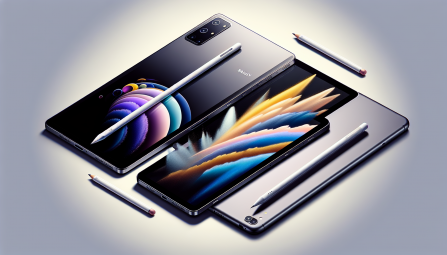
This already indicates a considerable difference, but what truly sways my decision is that Samsung provides its S Pen stylus in the package. As someone who appreciates taking digital notes (and it’s also ideal for digital art), this is a significant advantage.
Chris Hall / Foundry
On the other hand, Apple charges an additional £79/$79 for the newest Apple Pencil. Altogether, I would end up investing £179/$179 more for the new iPad Pro, in addition to already paying more for the device itself.
Thus, it becomes evident that the latest iPad Pro isn’t suitable for me. However, it remains an impressive device that could stand toe-to-toe with any of the best tablets available currently.
Interested? Pre-orders for the new iPad Pro are live now in the UK and US, ahead of its release on 22 October.
Summary
For my needs, the Tab S11 Ultra is the clear winner, whereas the iPad Pro… can keep the leftovers.